KituBox vs. Zoho vs. Odoo: Which Is Right for a Kenyan Business?
Zoho and Odoo are both genuinely capable platforms used by businesses around the world, and this is not an argument that they are bad software. It is a more specific question: if you are running a business in Kenya, which one actually fits how your business operates day to day?
The honest answer is that it depends on what you are optimizing for. Here is the comparison broken down by what actually differs structurally, rather than a simple better-or-worse verdict.
Built around different assumptions
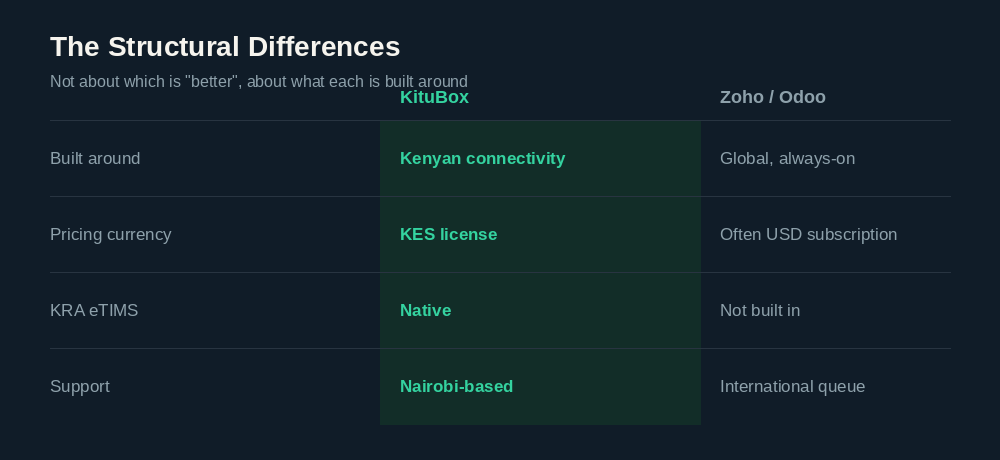
Zoho and Odoo are built for a global market first. That is not a criticism, it is simply the market they were designed to serve, and it shows in what they assume by default: constant connectivity, a level of card-based payment infrastructure, and compliance frameworks that were not designed with Kenya specifically in mind.
KituBox starts from the opposite direction. It was built assuming Kenyan conditions from day one: connectivity that is not always reliable, M-Pesa as a primary payment method, and KRA eTIMS and statutory payroll requirements as core functionality rather than an add-on.
Neither approach is wrong. They are built around different starting assumptions, and which one matters more depends entirely on where your business operates.
Pricing currency matters more than it seems
Zoho and Odoo are commonly billed as monthly or annual subscriptions in US dollars, per user. Over a year, that adds up, and it is exposed to exchange rate movement that a Kenyan business has no control over.
KituBox is licensed in KES. For budgeting purposes alone, this is a meaningfully different experience, even before comparing feature sets.
Kenyan compliance: native versus adapted
This is probably the single biggest practical difference. KRA eTIMS invoicing, PAYE, NSSF, SHIF, and Housing Levy are specific Kenyan requirements. Global platforms can sometimes be configured or extended to handle them, often through third-party add-ons or manual workarounds, but they were not built around these requirements from the start.
KituBox was. eTIMS signature tracking, Kenyan statutory leave types, and payroll deductions are core parts of the system, not a workaround bolted onto a platform designed for another market.
Support: local team versus international queue
When something breaks and you need it fixed the same day, the difference between a WhatsApp message to a Nairobi-based team and a support ticket routed through an international queue is significant. This is less about feature comparison and more about what happens when something actually goes wrong.
So which one should you choose?
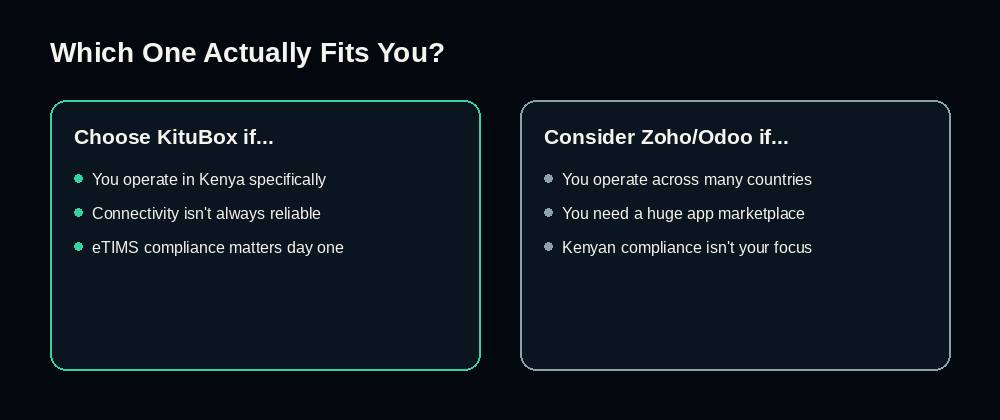
If your business operates specifically in Kenya, connectivity is not always guaranteed, and eTIMS or statutory payroll compliance matters to you now rather than eventually, KituBox is very likely the more practical fit.
If you operate across multiple countries, need an extremely large third-party app marketplace, or Kenyan-specific compliance genuinely is not a priority for your business, Zoho or Odoo's broader global ecosystem may serve you better.
Taxora Digital Solutions is a certified KituBox partner based in Nairobi, and handles the full setup, training, and support for any of the five KituBox products: ERP, POS, HR, Payroll, and CRM. If you are trying to work out whether it is the right fit for your specific business, that is exactly the kind of question a short conversation can answer faster than a feature comparison ever will.
Have a question about your own compliance setup?
Ask on WhatsApp