Best Business Software for Kenyan SMEs in 2026
Most Kenyan businesses do not wake up one day and decide to buy an ERP system. It usually happens gradually. A spreadsheet stops being enough. A till starts losing sales when the internet drops. A spreadsheet of employee leave becomes impossible to keep straight. At some point, the manual approach costs more time than the software would.
This guide walks through the five categories of business software most growing Kenyan SMEs eventually need, and what actually matters when choosing between them.
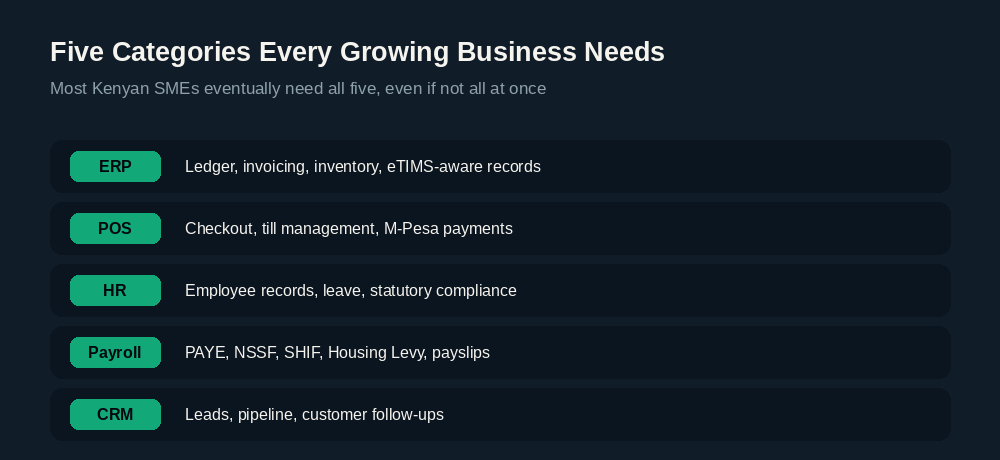
The five categories, briefly
ERP software is the foundation. It handles your ledger, invoicing, inventory, and financial reporting in one place. For a Kenyan business, the most important question is whether it understands KRA eTIMS requirements natively, since that is not optional for most VAT-registered businesses.
POS software is what your till actually runs on. For retail and hospitality businesses, this is the system your staff touch dozens of times a day, so speed and reliability matter more here than almost anywhere else.
HR software centralizes employee records, leave tracking, and statutory compliance. As a team grows past a handful of people, tracking this by hand becomes genuinely risky, not just inconvenient.
Payroll software handles PAYE, NSSF, SHIF, and Housing Levy calculations and filings. Manual payroll is one of the easiest places for a small, honest mistake to become an expensive compliance problem.
CRM software tracks leads, deals, and customer follow-ups. For any business doing active sales outreach, a shared pipeline is the difference between a coordinated sales process and hoping everyone remembers to follow up.
What to actually look for
This is where most comparisons go generic, so it is worth being specific about what actually matters for a business operating in Kenya.
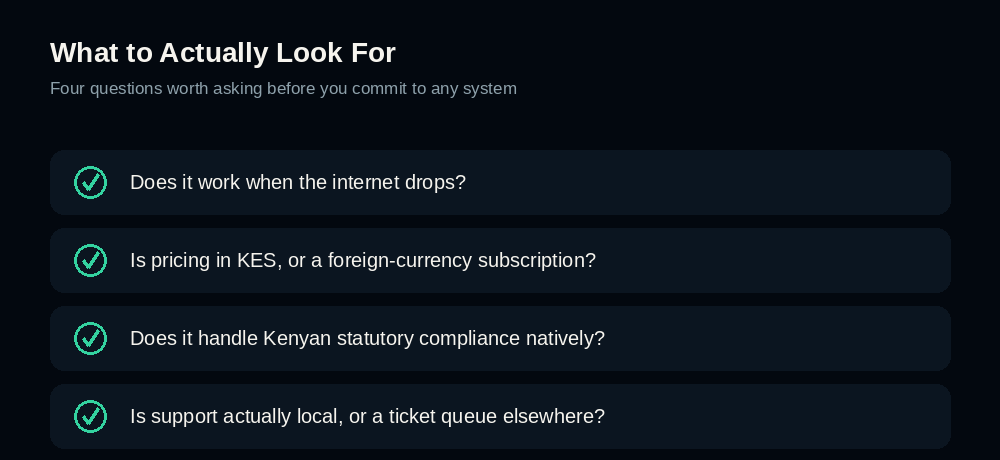
Does it work when the internet drops? A lot of business software, especially the well-known global platforms, assumes a constant connection. That assumption does not always hold in Kenya. Software that keeps working offline and syncs automatically once you are back online is not a nice-to-have, it is closer to a requirement.
Is pricing in KES, or a foreign-currency subscription? A monthly subscription billed in US dollars is exposed to exchange rate movement in a way a KES license fee is not. This matters more than it seems like it should when you are budgeting a year ahead.
Does it handle Kenyan statutory compliance natively? eTIMS for invoicing, and PAYE, NSSF, SHIF, and Housing Levy for payroll, are not universal requirements. Software built for a global market often treats them as an afterthought, if it handles them at all. Software built around Kenya treats them as the starting point.
Is support actually local, or a ticket queue somewhere else? When something breaks two hours before you need to close the books, the difference between a WhatsApp message to a local team and an international support ticket queue is not a small one.
Where KituBox fits
KituBox is a suite covering all five categories, ERP, POS, HR, Payroll, and CRM, built specifically around the four questions above. It is offline-first, priced in KES, built around Kenyan statutory requirements from the start, and supported locally by Taxora Digital Solutions, a certified KituBox partner based in Nairobi.
You do not need to adopt all five categories at once. Most businesses start with whichever one is causing the most pain right now, usually ERP or POS, and add the others as they grow.
If you are trying to work out which category your business actually needs first, that is exactly the kind of question worth asking before committing to anything.
More on Compliance
Kenyan Payroll Compliance Explained: PAYE, NSSF, SHIF, and Housing Levy
A plain-language breakdown of the four statutory deductions on every Kenyan payslip, and why manual payroll is one of the easiest places for a small mistake to become a costly one.
The Complete Guide to KRA eTIMS Integration for Kenyan Businesses
Everything a Kenyan business owner needs to know about KRA eTIMS: who needs to register, how integration actually works, the different connection types available, and what happens if you don't comply.
Common eTIMS Mistakes Kenyan Businesses Make (And How to Fix Them)
Five eTIMS mistakes we see again and again in Kenyan businesses, and exactly what fixing each one actually looks like in practice.
Have a question about your own compliance setup?
Ask on WhatsApp