Kenyan Payroll Compliance Explained: PAYE, NSSF, SHIF, and Housing Levy
Payroll in Kenya is not just a matter of paying staff on time. Every payslip has to correctly account for four separate statutory deductions, each with its own rules, rates, and filing requirements. Get one wrong, and it is rarely just an internal error. It can mean a real compliance penalty.
This guide breaks down what each deduction actually is, and where manual payroll tends to go wrong.
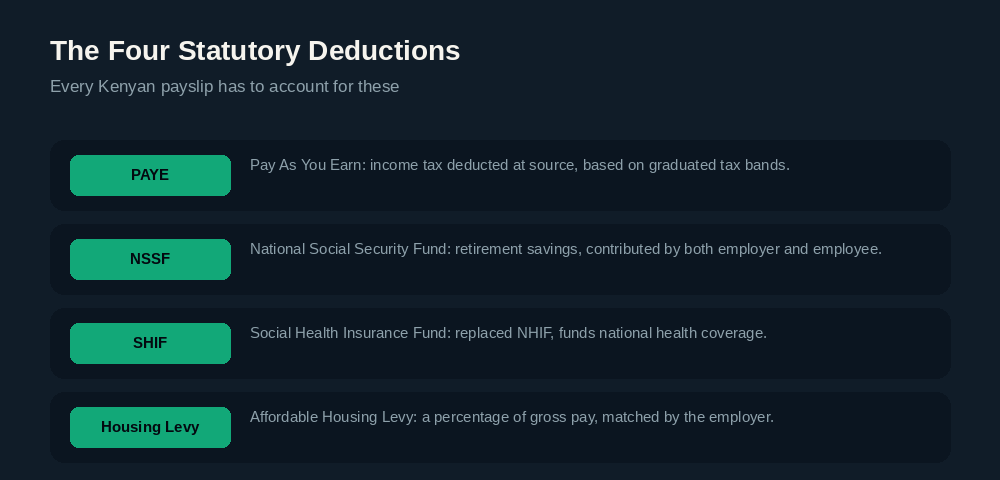
The four deductions, explained plainly
PAYE (Pay As You Earn) is income tax deducted directly from an employee's salary before it reaches them, based on graduated tax bands set by KRA. The employer is responsible for calculating it correctly and remitting it on the employee's behalf.
NSSF (National Social Security Fund) is a retirement savings contribution, split between employer and employee. It builds toward an employee's pension over their working life, and both contribution amounts have to be calculated and remitted correctly each pay period.
SHIF (Social Health Insurance Fund) replaced the old NHIF system and funds national health coverage. Like the deductions before it, it is calculated as part of each pay run and remitted on a set schedule.
Housing Levy (Affordable Housing Levy) is a percentage of gross pay, matched by the employer, that goes toward Kenya's affordable housing programme. It is one of the newer additions to the statutory list, and one that catches businesses off guard if their payroll process has not been updated to reflect it.
Why manual payroll is where mistakes happen
None of these four deductions are complicated in isolation. The difficulty is doing all four correctly, every single month, for every employee, while the underlying rates and rules periodically change.
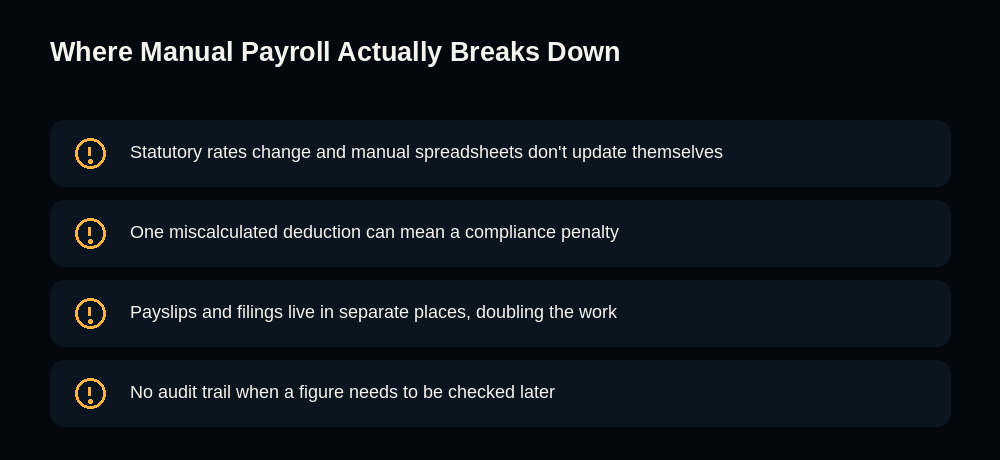
A spreadsheet does not know when a statutory rate has changed unless someone manually updates it. A single miscalculated deduction on one employee's payslip is easy to miss and can compound over several pay cycles before anyone notices. Payslips and the actual statutory filings often live in entirely separate places, meaning the same information gets handled twice, with two chances to introduce an error. And when a figure needs to be checked months later, whether for an audit or a dispute, a manual process rarely leaves a clear trail of exactly what was calculated and why.
None of this means a small business needs an accounting department to get payroll right. It means the calculation and filing process benefits enormously from being handled consistently by a system built specifically around these four requirements, rather than reconstructed by hand every month.
Where this fits with the rest of your business
Payroll rarely exists in isolation. Employee records, leave balances, and statutory details typically live in an HR system, and payroll needs accurate, current data from exactly that source to calculate correctly. This is why KituBox Payroll is built to connect directly with KituBox HR: a staff change entered once in HR flows straight into the next pay run, rather than being re-entered by hand into a separate payroll process.
If your business is still managing PAYE, NSSF, SHIF, and Housing Levy by hand, or piecing them together across a few different spreadsheets, that is exactly the kind of setup worth reviewing before the next statutory rate change catches it out. A short conversation is usually enough to see where the gaps actually are.
More on Compliance
Best Business Software for Kenyan SMEs in 2026
ERP, POS, HR, payroll, and CRM software all solve real problems for a growing Kenyan business. Here is what to actually look for before you choose any of them.
The Complete Guide to KRA eTIMS Integration for Kenyan Businesses
Everything a Kenyan business owner needs to know about KRA eTIMS: who needs to register, how integration actually works, the different connection types available, and what happens if you don't comply.
Common eTIMS Mistakes Kenyan Businesses Make (And How to Fix Them)
Five eTIMS mistakes we see again and again in Kenyan businesses, and exactly what fixing each one actually looks like in practice.
Have a question about your own compliance setup?
Ask on WhatsApp